
University · College IV
College IV: Operations and Business Management
This college covers the day to day operation and business side of a truck wash: throughput and staffing, pricing and menu design, fleet account management, customer service, marketing and sales, financial management, and technology. Each area connects the systems that turn equipment, chemistry, and labor into consistent service across every shift.
A truck wash lives or dies on what happens after the equipment is installed and the chemistry is dialed in. The building washes trucks; the business decides whether that work is profitable, repeatable, and worth running for years. College IV describes the knowledge areas an owner, operator, manager, or supervisor draws on to keep a facility busy, keep customers coming back, and keep the numbers healthy. It treats operations as one connected system rather than a stack of separate tasks, because in practice a staffing decision changes throughput, throughput changes revenue, and revenue changes what the pricing menu has to support.
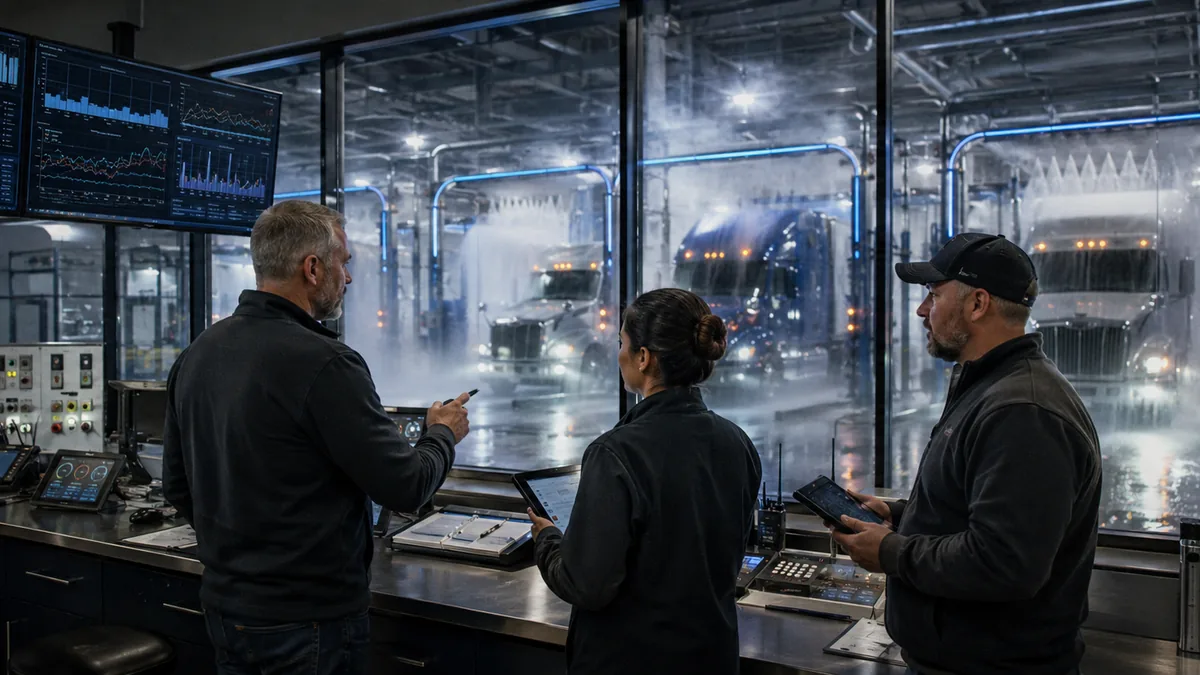
Daily operations and throughput
Throughput is the count of vehicles a facility can wash well in a shift, and it is set less by the size of the equipment than by how smoothly work moves through it. A wash that stalls between trucks, or that lets a queue back up onto the street during the morning rush, leaves revenue on the table even when the machinery is capable of more. Operators study cycle time, the sequence of steps at each bay, and the handoffs between prep, wash, and finish so that the next truck is ready to move the moment the last one clears. Peak management is its own discipline: knowing when demand spikes, staffing for it, and having a plan for the line so drivers are not turned away.
- Cycle time: the minutes from when a truck enters the bay to when it clears, and the bottlenecks that stretch it
- Bay sequencing: how prep, wash, and finish steps are ordered so no station sits idle waiting on another
- Queuing and lot flow: where trucks stage, how the line is managed, and how to avoid backups onto the road
- Peak and off-peak management: matching crew size and open bays to the volume a given hour or day is likely to bring
Staffing and labor
Labor is usually the largest controllable cost in a truck wash and the biggest driver of service quality, so staffing decisions touch both sides of the ledger at once. The work runs from bay attendants and prep crew to shift leads and a facility manager, and a well run site defines what each role owns rather than letting everyone do a bit of everything. Scheduling has to track expected volume so the wash is neither overstaffed on a slow afternoon nor short a person during the morning surge. Training shortens the time a new hire takes to reach a dependable pace, and it protects the equipment and chemistry from expensive mistakes. Retention matters because turnover resets that training clock and disrupts the consistency customers notice.
- Roles and responsibilities: clear ownership across attendants, prep crew, shift leads, and management
- Scheduling to demand: building shifts around expected volume rather than a flat headcount every day
- Training and onboarding: getting new hires to a safe, dependable pace on equipment and chemistry
- Retention: pay, conditions, and management practices that reduce turnover and protect service consistency
Menu and pricing strategy
The service menu is where a wash decides what it sells and what each service is worth. Most facilities offer tiers, from a basic exterior wash up to more thorough packages that add wheel and rim cleaning, brightener, undercarriage flush, or trailer work, plus add-ons a driver can choose at the point of sale. Pricing has to cover chemical and labor cost per vehicle and still leave margin, which means the menu and the operation have to be designed together rather than in isolation. Retail pricing for a walk-up truck is generally different from fleet pricing, where a negotiated rate is traded for reliable, recurring volume. Building the menu well means knowing the true cost of each service and setting prices that hold up when a fleet buyer asks for a discount.
- Service tiers: a clear ladder from basic exterior wash to fuller packages, each defined by what it includes
- Add-ons: optional services such as wheel brightener, undercarriage flush, or trailer wash sold at the point of sale
- Retail versus fleet pricing: walk-up rates compared with negotiated rates that trade a discount for recurring volume
- Cost to serve: knowing chemical, water, and labor cost per wash so every price on the menu protects margin
Fleet account management
Fleet accounts are the backbone of a stable truck wash, because they convert one time visits into predictable, recurring volume. A fleet account covers multiple vehicles under a single billing agreement, often with a negotiated rate, agreed service standards, and terms for how and when trucks are washed. Winning these accounts is a sales process that starts with understanding a carrier’s schedule, appearance standards, and cost pressures, then showing that the wash can meet them without slowing the fleet down. Keeping them is an operations process: consistent quality, accurate invoicing, and easy account handling so a fleet manager never has a reason to shop the business elsewhere. Billing is a real part of the work, covering purchase orders, monthly statements, per-truck or per-wash records, and clean reporting a customer can reconcile.
- Winning accounts: understanding a carrier’s schedule, standards, and cost pressures, then proposing terms that fit
- Keeping accounts: consistent quality and easy handling so a fleet has no reason to move its business
- Billing and terms: purchase orders, monthly statements, per-truck records, and clean, reconcilable reporting
- Service agreements: negotiated rates, appearance standards, and scheduling that keep the fleet moving
Customer service and retention
Drivers and fleet managers remember how they were treated as much as how the truck looked, and both decide whether they come back. Good service in this business is mostly consistency: the same quality on a Tuesday night as on a Friday morning, the same pace when the line is long, and clear communication when something goes wrong. Retention is cheaper than acquisition, so a facility that fixes a bad wash without argument and treats a driver’s time as valuable earns repeat visits that marketing cannot buy. For fleet customers, retention also means being easy to work with at the office level, with responsive account handling and problems solved before they escalate.
- Consistency across shifts: holding the same quality and pace regardless of the day or who is working
- Communication: setting expectations on wait times and handling issues clearly when they come up
- Recovery: making a bad wash right quickly, because how a problem is handled drives whether a customer returns
- Loyalty: repeat drivers and renewed fleet agreements that lower the cost of filling the schedule
Marketing and sales
A truck wash serves the traffic around it, so marketing starts with understanding local demand: the carriers, owner-operators, and vocational fleets that pass a site and how often they need a clean truck. Corridor visibility matters, since a wash near a busy freight route or a fuel stop draws walk-up volume that a hidden location never sees, and signage, listings, and directions all feed that flow. The higher value work is fleet outreach, a direct sales effort aimed at the carriers and municipalities whose recurring volume fills the schedule. That means identifying the fleets in a region, reaching the person who owns appearance and cost decisions, and making a case grounded in reliability and total cost rather than a single low price.
- Local demand: mapping the carriers, owner-operators, and vocational fleets that operate near a site
- Corridor visibility: signage, listings, and location near freight routes and fuel stops that drive walk-up volume
- Fleet outreach: direct sales to carriers and municipalities whose recurring volume anchors the schedule
- Positioning: competing on reliability and total cost rather than a single headline price
Financial management and KPIs
The financial side of a truck wash comes down to a handful of numbers a manager watches closely, because they show whether the daily work is actually paying off. Revenue per wash sets the ceiling on what a site can earn from its volume, while chemical cost and labor cost per vehicle set the floor under its margin. Utilization, the share of available bay hours actually spent washing, reveals whether the equipment and crew are being used or sitting idle. Watched together over time, these figures surface problems early: a rising chemical cost per wash points to a dosing or dilution issue, and a falling utilization rate points to a demand or scheduling problem. The table below summarizes the metrics operators track most often and what each one signals.
| Metric | What it measures | What it signals |
|---|---|---|
| Revenue per wash | Average dollars earned per vehicle served | Pricing, menu mix, and upsell effectiveness |
| Labor cost per wash | Crew cost divided by vehicles washed | Staffing efficiency against actual volume |
| Chemistry cost per wash | Detergent and chemical cost per vehicle | Dosing and dilution control, and product waste |
| Bay utilization | Share of available bay hours spent washing | Whether capacity is being used or sitting idle |
| Operating margin | Revenue left after operating cost | Overall health of the business |
- Revenue per wash: the average a site earns per vehicle, shaped by pricing and menu mix
- Cost per wash: labor and chemistry cost per vehicle, the two figures that most directly set margin
- Utilization: the share of bay hours actually spent washing versus sitting idle
- Margin and trend: what is left after cost, and how these numbers move month over month
Technology, POS, and data
Systems tie the operation together and turn daily activity into numbers a manager can act on. A point of sale system rings up walk-up washes, applies the right tier and add-ons, and records the transaction, while fleet billing systems handle recurring accounts, purchase orders, and statements. Behind the counter, the same tools capture the data that feeds the metrics above, so revenue per wash and cost per wash are read from records rather than guessed at. Loyalty programs, account portals, and equipment controls that log cycle counts and chemical use all add detail an operator can use to schedule staff, reorder supplies, and spot a trend before it costs money. The point is not the software itself but the visibility it gives into how the business is running.
- Point of sale: ringing up washes with the correct tier and add-ons and recording each transaction
- Fleet billing systems: managing recurring accounts, purchase orders, and monthly statements
- Operational data: cycle counts, chemical use, and sales records that feed the KPIs a manager reviews
- Loyalty and portals: tools that make repeat visits and account handling easier for customers and staff
Expanded workforce, sales, and technology subjects
The operating curriculum is also being expanded around the work that determines whether a site can hire well, sell recurring service, and use connected systems without losing control of cost or risk.
Workforce management
- Hiring wash attendants, structured onboarding, crew scheduling, and shift handoffs
- Productivity standards, including vehicles washed per labor hour and quality checks that prevent rushed rewashes
- Incentive compensation, supervisor training, coaching, discipline, customer service, and turnover reduction
- Spanish-language training where needed, using professional technical translation and native-speaker review
- Cash handling, fraud prevention, and career ladders from attendant through supervisor and manager roles
Business development and fleet sales
- Fleet prospecting, route building, bid calculation, and cost-per-truck modeling
- Contract terms, service-level agreements, price-escalation provisions, insurance requirements, and customer credit risk
- Proof-of-service systems, quality complaints, sales-pipeline management, and government or municipal bidding
Connected systems and operating data
- Point-of-sale systems, fleet accounts, RFID, license-plate recognition, cameras, and access controls
- Remote equipment monitoring, preventive-maintenance software, chemical-consumption monitoring, and water-use measurement
- Customer relationship management, KPI dashboards, and cybersecurity for connected equipment and business systems
How this connects across the program
Operations sit downstream of the decisions made earlier in the program and upstream of long term returns. The choice between a fixed site, a route service, or a hybrid shapes almost every operating decision on this page, and that groundwork belongs to the operating models knowledge area. The financial metrics here roll up into the longer view of profitability and return on investment, while fleet account work connects directly to Fleet Academy. Site selection and demand, the starting point for all of it, are covered in College I, and any unfamiliar term on this page is defined in the glossary.
What this covers: The subjects below make up this College. Content here is educational and describes the knowledge areas the field covers; it is not enrollment, certification, or professional advice.
Frequently asked questions
How do you run a truck wash profitably?
Profit comes from matching staffing to volume, moving vehicles through the bays without stalls, and pricing each service so it covers labor and chemical cost with margin left over. Operators watch revenue per wash against cost per wash and utilization, then fix whichever number is drifting. Recurring fleet accounts smooth out demand so the schedule stays full.
How do you win and keep fleet accounts?
Winning a fleet account starts with understanding the carrier’s schedule, appearance standards, and cost pressures, then proposing a rate and service terms that fit without slowing their trucks down. Keeping the account is an operations job: consistent quality, accurate invoicing, and account handling that is easy to work with, so the fleet manager never has a reason to look elsewhere.
What should a truck wash charge?
Pricing is set by each facility, market, and service menu, so there is no single figure. The method is what matters: know the labor, water, and chemical cost per wash, set tier and add-on prices that cover that cost with margin, and offer fleet customers a negotiated rate in exchange for reliable, recurring volume. This page does not publish specific prices.
What KPIs matter most in a truck wash?
The core metrics are revenue per wash, labor and chemistry cost per wash, bay utilization, and operating margin. Watched together over time they show whether the daily work is paying off and surface problems early: a rising chemical cost per wash points to a dosing issue, and a falling utilization rate points to a demand or scheduling problem.
Who is College IV for?
Owners, operators, managers, and supervisors responsible for running a commercial truck wash day to day, along with anyone studying how the business side of the industry works. The knowledge areas apply to fixed sites, route service operations, and multi-location businesses.