
University · College I
College I: Feasibility and Development
College I covers how a commercial truck wash moves from idea to open doors: testing market and site feasibility, working through zoning, permitting, and wastewater rules, engineering the facility, planning capital and equipment, and running a launch. It treats the development stage as one connected sequence, where each early decision sets limits on the decisions that follow.
Feasibility and development is the stage where a truck wash exists only on paper, yet nearly every constraint the finished business will live with gets decided. The land, the approvals, the water and reclaim systems, the capital structure, and the equipment package are chosen here, and each choice narrows what the others can be. A site with weak utility service caps the equipment that can run on it. A capital plan set before the wastewater path is understood can miss the cost of pretreatment. Getting this stage right is less about any single answer and more about testing the whole project as a system before money is committed.
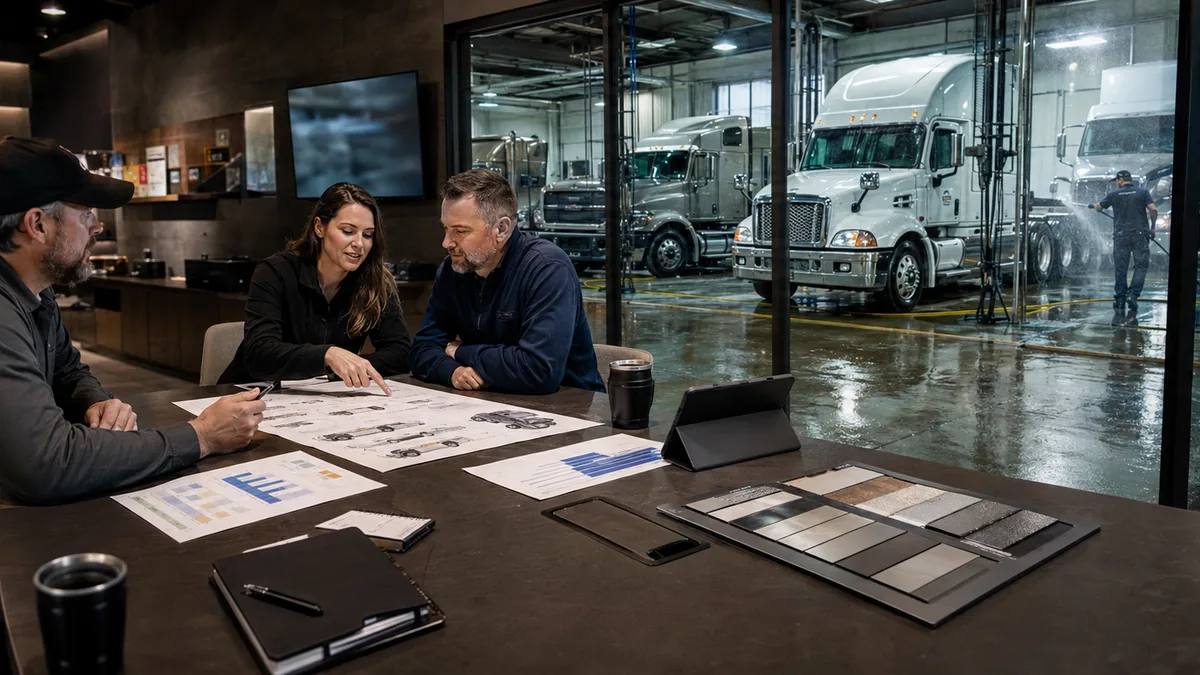
Market Analysis and Site Feasibility
Feasibility starts with demand, not with a lot for sale. The question is whether a corridor moves enough of the right trucks, often enough, to fill wash bays at a price that supports the build. That means reading freight-corridor traffic, understanding the local mix of fleets and owner-operators, and measuring existing wash capacity against it to find a genuine demand gap rather than a hunch. Only after the market case holds up does site screening make sense, because a strong site in a weak market still fails.
- Freight-corridor traffic: truck counts, directional flow, and the share of Class 8 and other commercial vehicles passing the location
- Demand-gap analysis: comparing likely wash volume against existing capacity within a realistic drive time
- Competition: number, format, condition, and pricing of nearby washes, and whether they serve fleets, retail traffic, or both
- Site screening: access and turning room for large vehicles, lot size and shape, utility availability, visibility, and proximity to fuel, rest, and freight infrastructure
Regulatory and Permitting
A truck wash is a water-using, water-discharging industrial use, so it moves through more regulatory review than a typical retail build. The path usually runs from land-use approval, through environmental permitting tied to wash and reclaim water, into building and fire-code review. Wastewater is the piece that most often reshapes a project: discharge to a sanitary sewer is governed under the federal Clean Water Act pretreatment framework and local sewer-authority limits, and those limits can require an oil-water separator, pretreatment, or a specific reclaim approach before a permit is issued. Understanding this sequence early keeps approvals off the critical path.
- Zoning and land use: confirming the wash is permitted or needs a variance, plus setbacks, parking, and stacking requirements
- Wastewater discharge: Clean Water Act pretreatment rules and local sewer-authority limits that shape reclaim, pretreatment, and separator needs
- Stormwater: managing runoff and containment so wash water and site drainage stay separated to the standard required locally
- Building and fire: structural, electrical, mechanical, and fire-code review for the bays, equipment room, and any chemical storage
Facility Design and Engineering
Design translates the market and the site into a building trucks can actually move through. The governing dimension is the vehicle: a Class 8 tractor-trailer needs bay length, door height, and approach and exit room that a passenger-vehicle wash never contemplates. On-site traffic flow matters as much as the wash itself, since a layout that stacks arriving trucks into the street or forces tight turns will bottleneck at peak. Water and reclaim design runs underneath all of it, sizing supply, pit, and reclaim capacity to the wash format and the discharge limits set during permitting.
- Site layout: entry, queuing, wash, and exit arranged so trucks flow one direction without conflicting movements
- Bay sizing for Class 8: length, width, and clear height to accommodate full tractor-trailer combinations
- Water and reclaim systems: supply capacity, wash-pit design, and reclaim sized to the format and to discharge limits
- Traffic flow: on-site circulation, queue length, and street access reviewed against expected peak volume
Capital Planning and Financing
The capital plan turns the design into a number and tests whether the number works. A project budget accounts for land, sitework, building, equipment, permitting, and the working capital needed to reach a stable ramp. A pro forma then models revenue against operating cost to show whether the project services its debt and returns capital under conservative volume assumptions rather than best-case ones. Because financing terms shape how much building the project can carry, the capital structure and the scope are best worked out together, not in sequence.
- Project budget: land, sitework, structure, equipment, soft costs, permitting, and contingency
- Pro forma: revenue, operating cost, and debt service modeled under conservative volume assumptions
- Funding sources: the categories of debt and equity developers commonly evaluate, and how each affects scope and risk
- Working capital: the reserve that carries the business from opening through the ramp to steady volume
Equipment Procurement
Equipment is chosen to fit expected volume, not to impress on a spec sheet. A wash package sized well above realistic throughput ties up capital and space, while one sized below peak demand creates lines and lost revenue on the busiest days. The reclaim system has to match both the wash system and the discharge limits set in permitting, since the water the wash uses is the water the site has to treat or reuse. Procurement also weighs lead times, installation requirements, parts availability, and service support, because equipment that cannot be kept running does not earn.
- Wash system fit: matching format and capacity to expected daily and peak volume and to the vehicle mix
- Reclaim match: sizing reclaim to the wash system and to the discharge limits confirmed in permitting
- Serviceability: parts availability, service support, and the ease of keeping equipment running through daily use
- Procurement timing: lead times and installation needs coordinated with the construction schedule
Grand Opening and Launch
Opening is a process, not a date. Commissioning confirms that the wash, water, and reclaim systems perform as designed before any customer is charged, and it surfaces the adjustments every new build needs. Staffing and training come next, so the team knows the equipment and the service standard before volume arrives. Many operators run a soft launch at reduced volume to work out flow and process issues under real conditions, then build toward steady demand over a ramp period rather than expecting a full book on day one.
- Commissioning: testing wash, water, and reclaim systems against design before opening to customers
- Staffing: hiring and training the team on the equipment and the service standard ahead of volume
- Soft launch: opening at reduced volume to refine flow and process under real conditions
- Ramp: building toward steady demand over time, supported by the working capital reserve planned earlier
How the stages connect
Each area feeds the next, which is why a decision made in isolation tends to surface as a problem later. The table below maps each knowledge area to the main decision it settles and the constraint it hands forward.
| Knowledge area | Central decision | Constraint it sets |
|---|---|---|
| Market and site feasibility | Where and whether to build | Traffic, lot, and utility limits |
| Regulatory and permitting | What the site is allowed to do | Discharge and code requirements |
| Facility design | How trucks move and wash | Bay and throughput capacity |
| Capital planning | Whether the numbers work | Budget and scope ceiling |
| Equipment procurement | What runs in the bays | Volume the wash can serve |
| Grand opening | How the business starts | Ramp pace and staffing |
Where the developer guide goes deeper
College I frames the knowledge areas the field covers. The developer-facing companion is the Business School pillar, How to Build a Truck Wash, which works through the same ground as practical guidance. Its clusters go deeper on each early decision: the feasibility study, site selection, cost to build, and permits and compliance. Once the site and capital are set, the equipment and systems taught next appear in College II: Wash Systems and Equipment. Unfamiliar terms are defined in the glossary.
Frequently asked questions
What does the feasibility and development stage of a truck wash cover?
It covers everything decided before opening: market and site feasibility, regulatory and permitting review, facility design and engineering, capital planning and financing, equipment procurement, and the launch. College I presents these as one connected sequence rather than separate tasks.
Why does permitting matter so early in development?
Because a truck wash discharges water, the wastewater path can dictate design and cost. Clean Water Act pretreatment rules and local sewer limits may require reclaim, pretreatment, or a separator, so understanding the approval sequence early keeps it off the critical path.
How is equipment matched to a site?
Equipment is sized to expected daily and peak volume and to the vehicle mix, then checked against the site’s utilities and the discharge limits set in permitting. The reclaim system has to match both the wash system and those limits, since the water used is the water the site must treat or reuse.
Does this page promise a budget, timeline, or return?
No. Project budgets, timelines, permitting outcomes, and operating results depend on local evidence and a specific project, so none are promised here. The page describes the knowledge areas the field covers, not a guaranteed result.
Where can a developer go deeper than College I?
The Business School pillar, How to Build a Truck Wash, is the developer-facing companion, with clusters on the feasibility study, site selection, cost to build, and permits and compliance. College II then covers the wash systems and equipment that follow from these decisions.
What this covers: The subjects below make up this College. Content here is educational and describes the knowledge areas the field covers; it is not enrollment, certification, or professional advice.