
University · College V
College V: Maintenance and Technical Services
This college covers keeping a truck wash running: preventive maintenance, pumps and motors, hydraulics and pneumatics, electrical and control troubleshooting, water and reclaim system upkeep, and parts and uptime management. The focus is practical: reduce unplanned downtime, extend equipment life, and keep every bay washing on schedule.
In a truck wash, uptime is revenue and downtime is lost washes. Every minute a bay sits idle for a failed pump, a tripped sensor, or a clogged reclaim line is a minute no truck moves through and no ticket rings up. Maintenance and technical services is the discipline that keeps the equipment from College II turning water, chemistry, and brushes into finished trucks, shift after shift.
Preventive Maintenance Programs
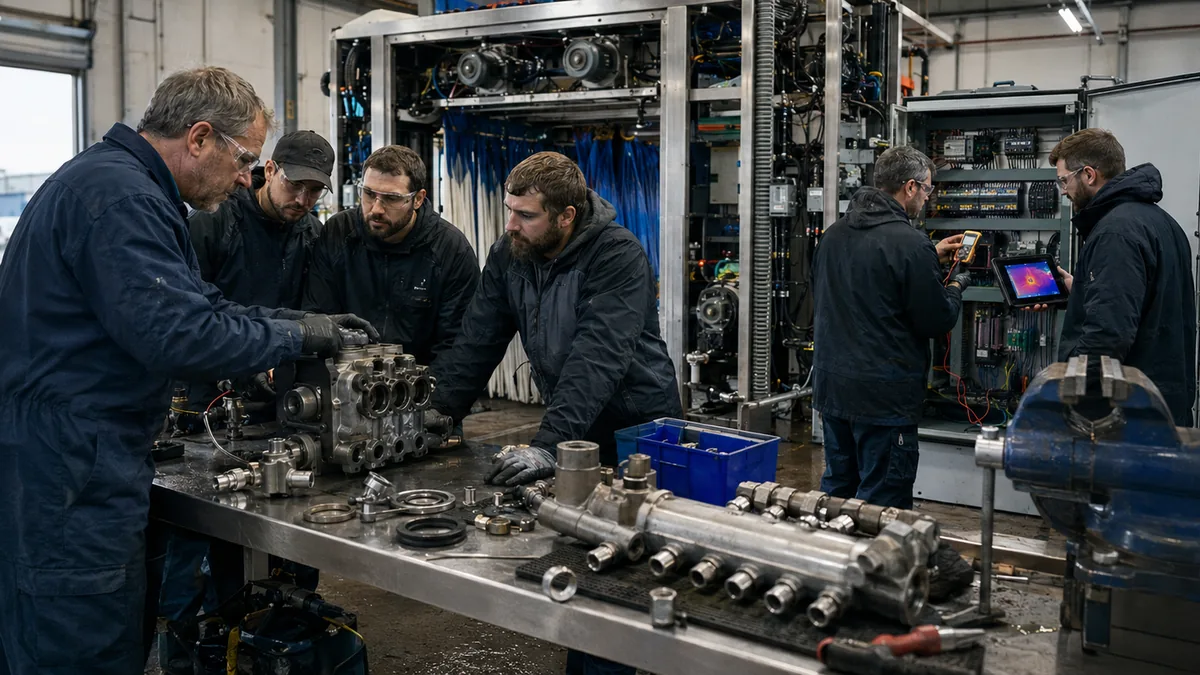
Preventive maintenance replaces guesswork with a schedule. Instead of waiting for a component to fail during a busy shift, technicians inspect, lubricate, and replace wear parts on set intervals tied to run hours or calendar dates. A written program pays for itself: a worn belt caught during a Tuesday inspection costs a few dollars and ten minutes, while the same belt snapping mid-cycle can strand a bay, damage a pulley, and back up a line of trucks.
- Daily, weekly, monthly, and annual inspection checklists tied to run hours and calendar dates
- Lubrication schedules for bearings, chains, and moving joints
- Wear-part replacement intervals for belts, nozzles, seals, and brushes
- Maintenance logs that record what was done, when, and by whom
- Trend review to spot components that fail earlier than expected
Pumps and Motors
High-pressure pumps and their motors are the heart of a wash. They run under load for hours, and small problems compound fast. Technicians learn to read the signs of wear before failure: pressure that drifts, seals that weep, bearings that run hot, and couplings that fall out of alignment. Correct alignment and clean fluid extend pump life more than almost any other single practice.
- Reading pressure and flow to detect worn seals, valves, or nozzles
- Mechanical seal and packing service to control leaks
- Bearing inspection, lubrication, and temperature checks
- Shaft and coupling alignment between motor and pump
- Common failures: cavitation, running dry, overheating, and electrical faults in the motor
Hydraulics and Pneumatics
Gantries, arms, gates, and brush assemblies move on hydraulic and pneumatic power. When an actuator stalls or a valve sticks, a wash cycle stops in place. Technicians trace pressure through the circuit, check for leaks and contamination, and keep air systems dry and clean so cylinders and solenoids respond the same way every cycle.
- Hydraulic and pneumatic actuators that drive gantries, arms, and gates
- Directional and pressure-control valves, and how a stuck valve stalls a cycle
- Air compressors, dryers, and water separators that keep the air supply clean
- Hose, fitting, and seal inspection to find leaks before they drop pressure
- Fluid cleanliness and filtration to protect precision components
Electrical and Controls Troubleshooting
Modern washes run on sensors, relays, and programmable controllers that sequence every step. When a bay faults, the cause is often electrical: a proximity sensor out of range, a relay that no longer pulls in, or a controller input reading the wrong state. Technicians work from the control logic and wiring diagrams, and they follow lockout and safety procedures before touching anything energized.
- Proximity, photo-eye, and position sensors that tell the controller where a truck and the equipment are
- Relays, contactors, and motor starters, and how to test a coil or a contact
- Programmable controller faults, fault codes, and reading input and output states
- Wiring diagrams and systematic tracing to isolate a fault
- Lockout and safety procedures before servicing energized equipment
Water and Reclaim System Maintenance
A reclaim system lets a wash reuse water instead of buying and discharging fresh volume on every cycle, and it only works if it stays maintained. Filters load up, settling tanks fill with solids, and stagnant water grows biology that produces odor. Technicians keep filtration clean, pump out solids on schedule, and manage biological activity so reused water stays clear enough to wash with and does not turn the site sour.
- Multi-stage filtration and screen cleaning to keep reused water clear
- Settling and reclaim tank pump-out and solids removal
- Biological control and odor management in stored water
- Fresh-water make-up, softening, and spot-free rinse systems
- Coordination with the discharge and permit topics covered in College VI
Parts Inventory and Uptime Management
The fastest repair is the one where the part is already on the shelf. Uptime management is as much about logistics as wrenches: knowing which spares fail often, stocking the critical few, and keeping vendor relationships that get the rest overnight. Tracking how long repairs take, and why, turns a pile of work orders into a plan for cutting future downtime.
- Critical spares to stock on-site: nozzles, seals, belts, sensors, and common valves
- Vendor and supplier relationships for fast sourcing of longer-lead parts
- Mean time to repair tracking to find the failures that cost the most downtime
- Work-order and service history records that feed the preventive program
- Deciding what to keep in-house versus what to contract out
Maintenance load is set long before the first breakdown. If you are planning a new site, the developer guide in the Business School covers how equipment choices shape the upkeep you will carry for years. For definitions of the terms used across these colleges, see the glossary.
Frequently asked questions
How often should truck-wash equipment be serviced?
It depends on run hours and the manufacturer’s guidance, not a single rule. Most operators run daily visual checks, weekly and monthly inspections of pumps, belts, and sensors, and larger service intervals tied to run hours. Always follow the intervals in your equipment manuals.
What are the most common truck-wash equipment failures?
Worn pump seals and nozzles, snapped or slipping belts, sensors knocked out of alignment, sticking valves, and clogged reclaim filters. Most share a root cause: a wear item that a scheduled inspection would have caught before it failed under load.
How do you reduce downtime at a truck wash?
Combine a written preventive program with a stock of critical spares and clear service records. Catching wear early, keeping the common failure parts on the shelf, and tracking how long repairs take are the three practices that cut unplanned downtime the most.
Should maintenance be done in-house or contracted out?
Many operators do both. Routine inspections, cleaning, and common part swaps are often handled in-house by trained staff, while specialized electrical, controls, or major pump work is contracted to a service provider. The right split depends on staff skill, volume, and how fast you need repairs.
What safety practices apply to truck-wash maintenance?
Lockout and tagout of energized and pressurized equipment before service, proper personal protective equipment around chemicals and high pressure, and following the procedures in each equipment manual. Never bypass a safety interlock to keep a bay running.
What this covers: The subjects below make up this College. Content here is educational and describes the knowledge areas the field covers; it is not enrollment, certification, or professional advice. Always follow equipment manuals and lockout and safety procedures.